
Unless you’re planning on carrying everything you need in a bandana at the end of a stick, a reliable backpack is a must-have when venturing out to the Great Outdoors for some hiking, trekking and camping.
When faced with the huge variety of models and shapes, choosing the right one for your trip can seem impossible at best, and that’s why I’m bringing you 5 essential tips every hiker and camper must know when choosing a new backpack!
Let’s get started!
Why, where and for how long?
First things first, you need to decide where you’ll be going and why.
Are you going sightseeing? Or perhaps you’re going on a wild camping trip for a week?
As someone who sold backpacks for several years, I can tell you one of the most common mistakes my clients made was coming to the store to buy a backpack with no idea of what they were going to do with it. Knowing that will make the whole process faster and easier.
So, make sure to know what you’ll be doing and where so you can choose a backpack with a level of durability, size and comfort suited to your trip.
Choose the right volume for your trip
The volume is tied directly to the length of your trip.
The longer the trip, the more food, gear and clothing you’ll have to carry and the larger the bag will have to be. When looking at the volume, we can separate backpacks in three categories:
Day packs: 5L – 30L
Day packs are small and intended for daily use, so something you might want for a short hike or some sightseeing, or simply if you don’t need to carry a lot of stuff. Of course, if you’re a light packer, you can probably fit all the gear you’ll need for a couple of days.
Travel packs: 30L – 50L
Travel packs are medium to large sized, and are the ones that I personally prefer and use the most. If, like me, you prefer to travel light, a backpack with a volume between 40 and 50 l will be large enough for most short to medium length trips (2 to 5 days). Because they are so versatile, they are ideal for beginners who don’t want to invest too much money, or for hikers who want something more multi-use.
Trekking packs: 50L and up
Trekking packs are the top of the range in terms of size and are suited for activities that require you to carry a lot of gear, such as extended wild camping trips or trekking and mountaineering expeditions.
But why can’t I just use a large backpack for all my outdoor activities, I hear you ask?
Apart from the fact that it would be pointless to carry such a large bag around for no reason, you’ll also probably won’t be carrying enough gear to fill it properly.
This will cause the weight of all the material you’re carrying to fall towards the bottom of the bag. Because of that, the weight distribution won’t be equal, and you’ll be putting a bigger strain on your lower back and shoulders. On the long run it can go from being annoying to painful, potentially ruining your trip.
Something else to keep in mind is that the volume of some backpacks is extensible.
This is usually indicated with a + sign, followed by the number of extra liters. The extension is usually either achieved by opening zippers or by pulling out an extension underneath the head of the backpack.
As you can see, my Deuter Guide 45+ has an extension of 10l on the top, bringing the total volume to 55l.
While this is practical, I don’t recommend filling an extensible backpack to max capacity. Doing this will cause the backpack to be very long and might give some problems with balance.

Find a good weight and durability ratio
The weight of a backpack is not only a factor that needs to be taken into account when packing, it will also influence how rugged and durable it is, and therefore how well it will hold up in rough conditions.
When looking at the weight of a backpack always remember the golden rule that applies to all outdoor gear:
The lighter it is, the less durable it becomes.
That’s bad news for all those shiny and expensive ultralight backpacks. Sure, if you pack light and want to minimise the weight then they are perfect. But if you want them to last a lifetime you’re better off with something a little heavier.
On the other hand, while one can make the point that a heavy backpack means it is more durable, it is not always the case. A cheap model can also be made using cheap and heavy fabrics, while at the same time a high-end, expensive model can be made using heavy but high-quality and durable materials.
Always research the production quality of the brand you’re interested in, and find the best compromise between weight and durability.
Make sure it is comfortable
It doesn’t matter if you’re going on a two day trip or for fifteen, your backpack needs to be able to carry the weight you need, stay in one piece and, above all, be comfortable and ergonomic.
The only way to make sure the backpack you’re interested in is any good is to try it on, but we first need to be familiar with the main parts that are responsible for making it comfortable:
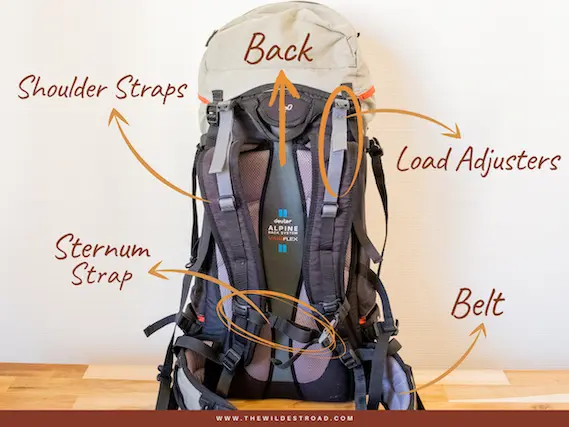
The back
The back of your backpack is the part directly in contact with your back (uff, that’s a lot of backs!). It is usually either padded with foam or has a fabric or plastic mesh. The mesh makes it so your back doesn’t stick to the backpack, allowing for a better airflow and dispersion of heat.
I don’t particularly recommend these on large backpacks, for two reasons:
- If it’s hot enough the mesh will end up sticking to your back anyway, so on the long run it won’t make much of a difference.
- It creates a gap that separates your body from the bulk of the backpack. The closer your body is to the backpack, the easier it will be to carry. This gap means that if you’re carrying a large weight, the backpack will pull you slightly off-balance and will press more on your shoulders.
Keep this in mind when choosing, go for a padded model if you’re planning on carrying a lot of weight.
Shoulder straps
Along with the belt, the shoulder straps will be responsible for holding the weight of the pack, as well as adding to the overall comfort.
Thin straps can have the tendency to dig into your shoulders over time, so make sure they are wide and well padded for extra support!
Load adjuster straps
On large models, make sure you have load adjuster straps. They are located on top of the shoulder straps and when tightened, they will shift more weight to your hips, relieving it from your shoulders and allowing you to work more with your legs than your back.
Sternum strap
On the front you of the shoulder straps you will find a sternum strap. When properly tightened it will keep the backpack centred on your back, improving your balance.
Belt
The belt is the main weight carrier of your backpack, so always make sure it is well padded and suited to your body size.
A belt that is small, floppy and with little padding can probably support a weight of up to 5 kg (11lbs). Anything above that will require a belt that is thicker and more rigid, so that it can properly hold the weight off your shoulders.
Know how to properly fit your backpack
After you’ve found a model you like and that fits the volume, weight and durability you need, you’ll have to know how to adjust it to your body shape.
Fitting a backpack is essential, especially when carrying a heavier load.
A bad fitting means that the weight will end up falling entirely on your shoulders, which is likely to ruin your trip and make you miserable, as well as risk causing some serious back damage on the long run.
Fitting a backpack is easy, the key is to ALWAYS follow this order:
- Loosen the straps on the belt, the shoulder straps, the load adjusters and the sternum strap.
- Put the backpack on.
- Tighten the belt right over your hip bone. You’ll know it’s well placed if you can let the backpack hang off your hips without it falling off.
- Tighten the shoulder straps until they hug your shoulder, but not so tight they dig in the skin.
- Tighten the sternum strap. Make sure it’s just tight enough to stretch across your chest while still allowing you to move and breathe easily.
- Slightly tighten the weight loaders, don’t pull them all the way, just enough to relieve the weight from your shoulders.
You can play with the tightness of the straps to fit your preference. You’ll know the backpack is well fitted when the weight rests comfortably on your hips, with the shoulders and sternum straps providing support and balance.
If the belt seems to be sliding up it means the distance between the belt and the shoulder straps is too small. If on the other hand you seem to have a gap between your shoulders and the the shoulder straps, you either didn’t follow the correct adjustment order or the back is too long.
Most large backpacks have an adjustable back, meaning that the length can be regulated to fit you. Some brands even take it a step further with a small, medium and large system, so keep an eye open for that. This doesn’t affect the volume of the backpack but it makes it easier to adjust it perfectly.
I know by experience that choosing a new backpack can be long and exhausting, but remember these tips and choosing the best model for your trip will be a breeze!


