Whenever we hit the trail for a few days of camping or a hike, a reliable knife is one of the things we’re always sure to pack.
There are an infinite number of ways a knife could be useful when you’re in the wild, from chopping sticks for a fire, to prepping your outdoor meals and even making an emergency shelter if things unexpectedly go south!
But how do you choose the best outdoor knives for you and for your activities?
With so many models, sizes and brands out there, it’s easy to get lost and end up choosing a knife just because it looks cool and because it’s what you think you might need.
It’s a mistake we’ve definitely made ourselves. So, with that in mind, let’s jump into this outdoor knife buying guide and learn how to choose outdoor knives that you can rely on when hitting the trail.
Let’s get started!
Different knives, different outdoor activities
Outdoor knives are tools like any other, and what you need is the right tool for the job.
For example, a foldable pocket knife would be a poor choice for wild camping, just like a machete would be a complete overkill for a day-hike in the woods. Many outdoor knives are also equipped with features such as serrations and gut hooks that, while useful in the right hands, would be useless or even dangerous to a beginner.
So, the first thing to figure out is what exactly you’ll be doing with your knife. For simple meal prepping for example, such as cutting meat and vegetables, you wouldn’t need more than a simple 3” fixed blade with a decent handle.
An example of a small, compact outdoor knife that we love to carry on short trips is the Civivi Timberbark, since it’s light, reliable and very easy to use for small tasks while hiking or around camp.
It’s also equipped with one of the most common blade types you’ll find on the market, called a flat grind. You can easily recognise it because it is completely flat from the spine (the back) all the way to the sharp edge. Since flat grind outdoor knives are amazing slicers, they are a go-to option for hunters and the perfect choice for your camp kitchen.
This type of outdoor knife is also great for bushcraft. Flat grinds, however, need some regular sharpening because they dull rather fast, especially when used on harder materials like wood.
That’s why we generally prefer to use a different kind of knife called a scandi (short for Scandinavian), for all of our bushcraft activities.
Scandi knives are easily recognisable, as the blade starts flat from the spine and then tapers evenly along the length of the edge. In addition to being easy to sharpen and retaining their edge over long periods of time, the blade geometry of scandi knives makes them ideal for woodwork, such as carving, bushcraft and chopping.
A classic scandi is the iconic Mora Garberg, one of our absolute favourites to bring on hikes and camping trips, and overall one of the best outdoor knives ever made.
While these outdoor knife types are usually enough for most hiking and camping activities, there are definitely scenarios in which you might need something bigger. Survival knives are a broad category of large, thick knives that are meant to be used for anything from chopping wood to hunting and even self-defence from predators.
Out of all outdoor knife types, this is the one we don’t recommend for beginners; for the most part, survival knives are simply too heavy and cumbersome for someone without experience to handle safely. Still, if you’re set on trying out an affordable survival knife we recommend checking out the Cold Steel SRK. It’s an extremely reliable and affordable choice, making it a great first survival knife.
The difference between carbon and stainless steel outdoor knives
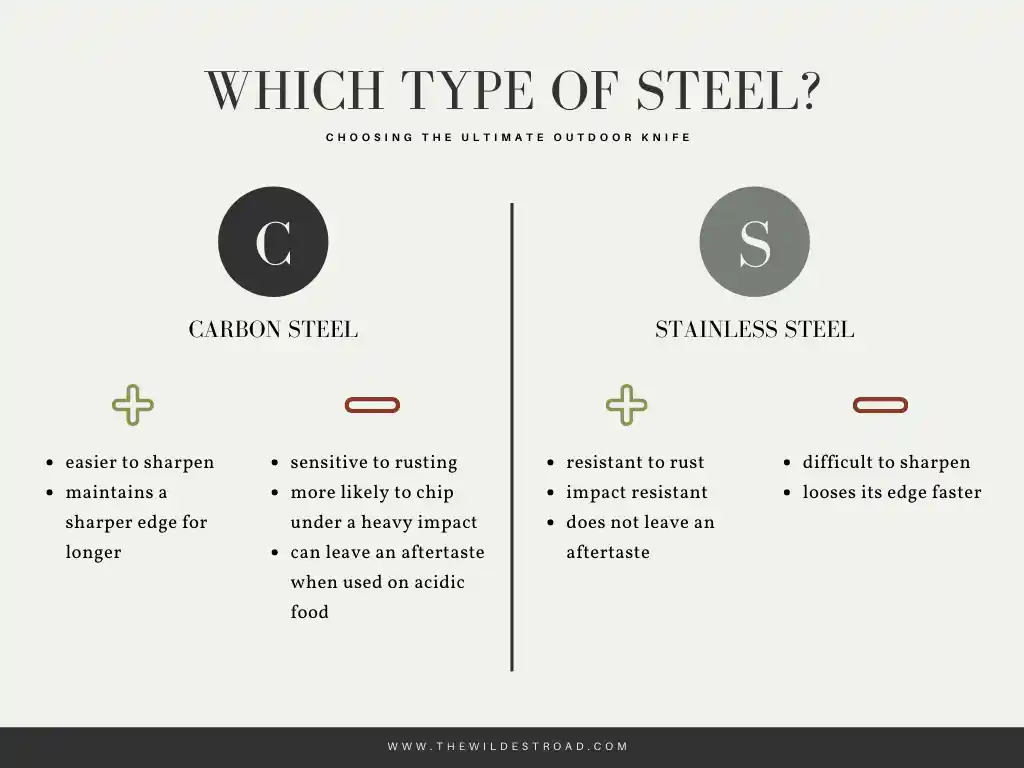
Essentially every knife available on the market is made of either carbon or stainless steel. While they look identical on the surface, they both have features that make them very different from one another.
Carbon steel is generally considered more beginner-friendly because of how easy it is to sharpen. It also holds a better edge and can become sharper than stainless steel, but is also extremely sensitive to rust and is more brittle and prone to chipping.
Stainless steel is a little more difficult to sharpen and generally won’t hold an edge for quite as long as carbon steel. On the other hand though, this type is extremely rust resistant and much harder to chip.
So, which one is better?
That depends entirely on your activities and environments. Stainless steel, for example, is the obvious choice when hiking and camping in wet and humid climates that would absolutely destroy a carbon steel knife without careful cleaning and maintenance. Long distance hikers and wild campers, however, might prefer a carbon steel outdoor knife over stainless because of how easy it is to sharpen on the trail.
When it comes to our personal preference, we usually choose stainless steel outdoor knives. While carbon steel is easier to sharpen, we love the versatility of stainless steel, and not having to worry as much about the blade rusting on the trail is for us a worthy trade-off.
Don’t forget to look at the handle
The handle is equally as important as the blade, and it needs to be comfortable, ergonomic and secure.
Outdoor knives that risks slipping from your fingers when wet, or that are shaped in a way that compromises your grip, are extremely dangerous for both you and your hiking buddies.
The material of the handle is also important to consider when making your choice:
- Wood is a classic choice for knife handles, but it’s also easier to break and can become slippery when wet.
- Rubber and plastic are more durable and offer a better grip, even though they don’t look as nice as a natural material.
- Leather is a less common material, but is still used in some classic models like the Ka-Bar USMC. Leather handles look great and offer a very secure grip, although they become slippery when very wet. However, they require regular maintenance and cleaning to prevent cracking and rotting.
For the best of both worlds, the materials we recommend the most for your first outdoor knife are micarta and G10. They are both composite materials that come in a variety of colours, offer a comfortable, grippy texture, on top of being extremely durable and resistant to wear-and-tear.
Something else to take into consideration when looking at the handle of your outdoor knives is the shape of the tang.
The tang is, very simply, the unsharpened part of the blade that extends into the handle. It comes in a variety of shapes and sizes that can greatly influence the performance of your outdoor knife:
- A full tang, in which it has the same thickness as the blade and extends to the bottom of the handle, makes the knife a lot more durable because it is composed by a single, continuous piece of steel. However, it also makes the knife heavier. This design is typical of high-end knives that offer maximum durability.
- A half-tang has the same thickness as the blade but is only half-way down the handle, offering a good compromise between durability and weight. It also makes the knife less balanced, however, since the blade is heavier than the handle. You will usually find half-tangs in small bushcraft knives.
- A rat-tail is a tang that is thinner than the blade. Rat-tail tangs are lightweight and tend to make the knife front-heavy, a characteristic that primarily benefits hunting and combat knives meant for stabbing and hacking at soft targets. Rat-tails, however, are also the least durable type of tang, and the most prone to breaking and bending.
And that’s pretty much it!
Choosing a knife for your outdoor adventures is actually pretty easy and straightforward once you know what to look for.
If you want to go further into detail about different blade shapes and grinds, don’t forget to read our dedicated post right here!