
As a teen, my first campout was at a summer festival where I slept inside a cheap tent, wrapped in an old sleeping bag placed on top of a yoga mat.
Not the most comfortable sleeping arrangement, but at that age I didn’t really care. The problem is that I then applied the same logic to a backpacking trip to Norway; despite travelling in July, I spent most nights curled up in a ball with all of my clothes on, desperately trying to avoid turning into a popsicle.
Sleeping bags are one of the most important items of gear for the outdoors, and choosing the wrong one for your trip can have serious consequences. In this post we’ll break down the essential specs that you need to look out for when shopping for a new sleeping bag, such as insulation, temperature rating and shape, to help you choose the best gear for your camping trips.
Let’s get started!
Check the label with the temperature rating
Many new campers make the same mistake I made all those years ago and assume they can just use one sleeping bag for any situations, but this couldn’t be further from the truth.
What you need to look out for is the three numbers (usually on the stuff bag of the sleeping bag) that show the temperature rating, which is the average air temperature your sleeping bag can insulate your from. Stray too far out of this range and you’ll either be too warm or you’ll freeze to death. And we mean that literally.
Let’s see, for example, the Gold Kazoo from The North Face. The numbers on the stuff bag indicate Comfort: +1°C (33.8°F), Limit: -5°C (23°F) and Extreme: -22°C (-7.6°F). Let’s take a look at what each of these numbers mean:
- Comfort:The best temperature on average to use the sleeping bag, so in this case around +1°C (33.8°F). Stay around this number and you’ll be fine, not too warm and not too cold.
- Comfort Limit:When in between this and the comfort rating, in our example -5°C (23°F), you’ll definitely start feeling chilly. This is the idea minimum temperature the sleeping bag is supposed to be used in, and if you drop below you will gradually start feeling a lot colder.
- Extreme: This rating is only meant as a safety net in case of unexpected temperature drops or cases of emergency, and you’re not supposed to normally use your sleeping bag in this range. If you reach this threshold, which with the Gold Kazoo is around at around -22°C (-7.6°F), you’ll feel extremely cold but should make it through the night, even though it will likely be the worst night of your life. If you drop even further below the sleeping bag will stop protecting you and will eventually succumb to hypothermia and death if you don’t find a way to warm yourself up.
It’s also super important to know that these are meant as average temperatures, so always choose a sleeping bag with a rating that is at least a few degrees above the lowest temperature you can expect during your campout.

Choose the right shape for your needs
While looking for a new sleeping bag, you might have noticed that they come in a few different shapes, mainly rectangular and tapered, also known as a mummy.
While there are other, smaller variations, the main point for these different shapes is to provide a balance between comfort and insulation.
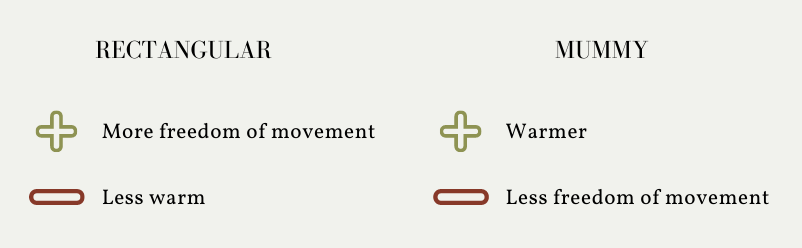
Sleeping bags insulate your body from the surrounding cold air, but the more space there is between you and the insulating material the faster the heat will escape your body. That’s why mummy sleeping bags tend to be made for colder weather, while rectangular sleeping bags are almost always meant to be used in warmer climates.
On the other hand, rectangular sleeping bags are a lot more comfortable as they allow for more freedom of movement, while mummy sleeping bags tend to be a lot tighter and more restrictive.
Some sleeping bags can be joined together
If you go camping with your significant other, you might like to know that some sleeping bags can be attached together and be used as one big bag.
Although you have to account for a small loss in insulation, we’ve been doing this for years with our Millet Baikal 750 for years and it always feels great to have a little extra space on warmer nights.
In order to do this you’ll need two sleeping bags with openings on opposite sides, which will generally be marked on the container bag with either an R (right) or L (left). Just remember that you’ll need two of the same sleeping bag, since sizes can vary in between brands and models.
Make sure that the sleeping bag can open completely and the two sides of the zipper can detach fully from each other. This is necessary so that the two sides of the zipper can be joined to the corresponding ones, left to right and right to left, on the other sleeping bag.
What is your sleeping bag filled with?
Sleeping bag fillings are usually made of either down feathers or a synthetic alternative such as polyester fibres. There are key differences that make carefully choosing between the two extremely important, so let’s take a closer look at what the specs of each are.
Down Filling
Down is a type of very light feather gathered from birds such as geese and ducks.
Sustainable productions harvest feathers either by removing them from animals slaughtered for consumption or by collecting them after they’ve been naturally shed. However, there are known cases of producers forcibly removing down feathers from live animals, so it’s critically important to make sure the model you’re checking out has the RDS (Responsible Down Standard) logo to certify it is made with humanely resourced feathers.
One advantage of down fillings is that, since they are warmer and fluffier than synthetics, there is less material needed inside the sleeping bag, making it lighter and more compact when stowed inside a stuff bag. These characteristics make them ideal for light packers.
Because of the nature of the filling, however, down sleeping bags are generally expensive. They are also very sensitive to humidity, as the filling easily absorbs water in the air and gives the inside of the bag a wet, uncomfortable feeling. It also reduces the warmth it can provide, and that’s why down sleeping bags are best used in dry environments. That also makes them ideal for cold climates, since these are usually associated with low air humidity.
Down sleeping bags also require more care than synthetic materials:
- It’s best to wash them in a machine without an agitator with a couple of tennis balls to fluff up the filling.
- Avoid using normal soap, and instead use a detergent meant for down fillings; the best down cleaner we’ve tested so far is definitely the Nikwax Down Wash Direct, which thoroughly cleans the down, removes smells and also makes it more humidity resistant, partially negating one of the biggest disadvantages of the material.
- You should always leave your sleeping bag to dry flat, since hanging and especially folding it in the middle will cause the down to accumulate and leaves gaps in the filling, overall reducing the effectiveness of the bag.
- Never put your sleeping bag in the drier, always let it dry naturally!
Synthetic Filling
Compared to down sleeping bags, synthetic fillings are more common and usually a lot cheaper.
Their main advantage is that, contrary to down, they absorb less humidity and are therefore better suited for a wider variety of climates. Like down sleeping bags, they can be washed in a machine without an agitator, and it is best to use an appropriate hiking gear detergent to keep your sleeping bag in top shape.
One major disadvantage, however is that synthetic fillings are not as warm compared to down, and need a lot more filling to be effective in very low temperatures. The result is that synthetic sleeping bags are always heavier than down sleeping bags with the same temperature rating.

Look for the best fill power
Simply put, the fill power indicates the fluffiness and quality of a down filling, so the higher the number the higher the fluffiness of the down. Fluffier down sleeping bags will offer more warmth and better comfort, so it’s an important value to look for. The fill power can range from 600 to 650 (good fill power), 700 to 750 (very good) and 800 to 950+ (top quality).
Look for ripstop sleeping bags
If you want your sleeping bag to last as long as possible, make sure it has ripstop.
Ripstop is a technology in which a mesh is sewn directly into the fabric, making it more resistant to piercing and ripping and preventing any hole or tear from becoming larger, giving you more time to perform repairs.
It tends to be a feature on premium and high-end models, but it’s well worth the extra money if you really want to maximise your gear’s longevity.
And there you have it!
This is everything you need to know to choose the best sleeping bag for your next adventure in the wild, no matter where or how rough the weather might be. Of course, sleeping bags are only half of the equation when it comes to spending a comfortable, warm night under the stars.
If you’re busy building your camping gear set, don’t forget to check out our guide on choosing a sleeping pad next!


