
Georgia is another one of many destinations we have been absolutely dying to visit.
With centuries of history, a fascinating culture and, you guessed it, absolutely incredible food, this small country in the Caucasus simply couldn’t remain on our bucket list any longer.
Continuing our travels through the region, we took a night train in Yerevan, Armenia, and after a ten hour ride we finally made it to Georgia’s capital, Tbilisi. It was an incredible city to explore and experience, and a very unique destination that always seemed to have something new hiding behind the corner.
In our Tbilisi travel guide we’ll share with you the in-depth breakdown of our time in this incredible city, along with some essential tips that we are sure will make planning your own trip a lot easier.
Let’s get started!
Flying directly to Tbilisi isn’t always the best choice
Flying to Tbilisi can be expensive.
The airport in the city of Kutaisi, however, is also well connected and is usually much more affordable to fly to and from, and is linked to the centre of Tbilisi by two bus companies which cover the trip in about two and half hours.
The schedule is based on which flights are arriving or departing, to ensure you arrive on time to the airport, and that you have a shuttle available to bring you to Tbilisi when you arrive. Both companies charge the same for a ticket, 25 GEL (9 USD) for adults and 15 GEL (5 USD) for kids aged 2 to 12. You can book your ticket online or directly on the bus with both cash or card, and If the bus is full a second one should normally arrive after a few minutes.
If you fly to Tbilisi, on the other hand, you have a couple of options to reach the city. Bus 337 runs directly between the airport and the main train station, and takes a little over an hour to cover the distance. By far the easiest way, however, is to simply call a cab with a car-sharing app such as Yandex or Bolt, just avoid taking a normal taxi as they’ll almost surely overcharge you.
Don’t forget that, depending on your nationality, you might need a visa to travel to Georgia. You can easily check if you’re exempt by using the Georgian government’s official portal.
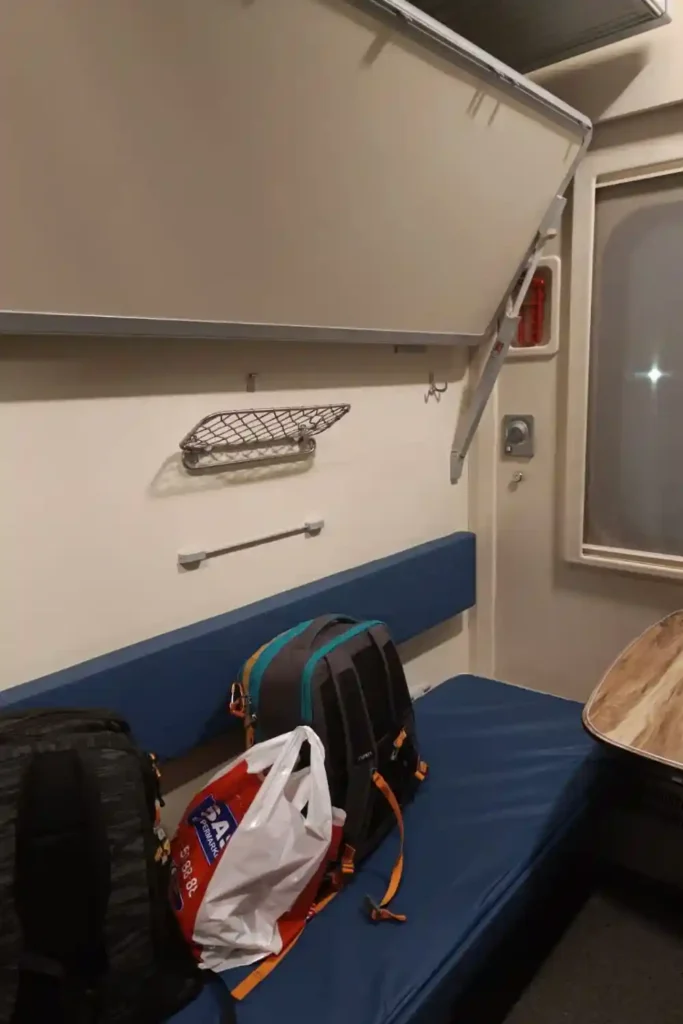
In our case, we arrived in Tbilisi via a sleeper train from Yerevan, which turned out to be a very budget-friendly and comfortable option, and one we would recommend to anyone planning on visiting both cities in the same trip, while avoiding expensive air travel options.

Grab yourself a SIM card
It’s worth getting a Georgian SIM card either when you arrive at the airport or in Tbilisi.
That way you’ll be able to freely use maps and take advantage of car-sharing apps to get around. Since we travelled to Tbilisi by train we bought a SIM card in the city, so we can’t tell you for sure if buying one at the airport will cost more.
For comparison, the two SIM cards we bought from MagtiCom with a week of unlimited data cost us a total of 40 GEL (14 USD).
Tbilisi is an incredibly varied city, and easy to get around
Tbilisi is a beautiful city with a fascinating variety of architecture.
But depending on where you are in the city, Tbilisi can look and feel very different.
The city centre reminded us a lot of Bohemian European cities, such as Prague, Budapest and even a little bit of Paris. The more you move further from the centre the more you’ll see more Soviet architecture, most prominently the classic giant apartment complexes.
The old town, on the other hand, is very small and charming, with narrow streets and alleys lined with old homes and shops, often with typical wooden balconies. Overall, the city gave us good vibes all around, and has a very lively atmosphere.
Tbilisi is a very walkable city, and relatively easy to explore on foot. With that said, we often found getting across some of the large avenues difficult due to a very surprising lack of underpasses and pedestrian crossings. We would sometimes see a place we wanted to go to right on the other side of the street, but would have to walk a distance before we would find a spot where we could safely cross.
We really got the impression that over the years the city has been built to be more car-friendly. In that sense it reminded us a lot of Kuala Lumpur, Malaysia, another city we visited that seems to have left pedestrians a little bit behind.

Fortunately, Tbilisi’s metro system is very efficient, although it’s important to say the trains are incredibly loud, to the point you can barely hear someone talking right in front of you.
The metro is very easy to navigate, as there are only two lines and you’ll be using Line 1 to reach the basically all of city’s points of interest.
As of 2025, tickets cost 1 GEL per ride (0.35 USD), and are stored in a “Metromoney” card that costs 2 GEL (0.70 USD) and that can be recharged at kiosks located in every station.
Keep in mind, however, that they only take cash; there are also ATMs in almost every station, but be sure to use Bank of Georgia as it doesn’t charge any additional fees to your transaction.
The weather can be hot and unpredictable
When we arrived in Tbilisi from Yerevan, we thought we had escaped the hot weather we had experienced for most of our time in Armenia.
That only lasted a day, after which the fresh air was replaced by an even worse heat. What surprised us is that the temperatures were not even that high, mostly around 25°C, but felt a lot more intense and sticky than what we’d normally expect in that range. Tbilisi is also known for its hilly terrain, and walking up the steep streets in the heat quickly became exhausting.
Compared to Yerevan, there are also few drinking fountains, and they are mainly found inside parks. We really recommend grabbing yourself a reusable water bottle to stay well hydrated, especially if you plan on travelling to Tbilisi during the summer. It goes without saying that sunscreen is also a must, since the sun beats down hard and most tourist sights are outdoors.
Tbilisi is much more touristy than what we had expected
Tbilisi is a very touristy city that receives visitors from all over the world, which results in some parts of the city getting very, very crowded during the high season.
This is most noticeable in some parts of the old town, and we were a little bummed out by seeing many tropes that are typical of popular tourist destinations, such as massage parlours, tuk-tuks driving around and annoyingly frequent tour offers on the street. We also saw some huge lines at the cable car stations that connect the city to the nearby hills, where many of the city’s most famous sights are located.
It’s worth mentioning that the most popular of these sights, Narikala Fortress, is unfortunately closed at least until the end of 2025.
One small advantage of the heavy tourism is that, at least in and around the city centre, most people speak at least basic English. It’s still worth learning a few words of Georgian, as the locals really appreciate it when visitors make a small effort to speak their language. Perhaps also due to tourism, we found Tbilisi to not be overly cash-based, although it’s worth carrying a bit of cash with you in case cards are not accepted.

We loved the sights in Tbilisi, especially the Chronicles of Georgia
Tbilisi has many cool and unique sights, such as the Leaning Tower of Tbilisi, a clock tower that offers a fun mechanical puppet show every day at 12h00 and 19h00.
One you can’t miss is Holy Trinity Cathedral of Tbilisi, commonly known as Sameba, one of the largest religious buildings in the world by total area and the third tallest Orthodox cathedral in the world. We found it fascinating how, despite its important status, the church still serves its basic function as a place of worship, and is free to visit for worshippers and tourists alike.
Another location we absolutely recommend you check out (even if its a bit far) is The Chronicles of Georgia, a fascinating monument that began construction in the 80’s as a tribute to the country’s history, but was never fully completed. The complex is free to visit, although it wasn’t the easiest to reach.
There are several ways to get to the Chronicles of Georgia: We took the metro from Liberty Square to M/S Guramishvili, and then followed Google Maps (screenshot google maps with path) through a rural residential area; there we had to be extra sure to avoid accidentally walking onto someone’s property because of the presence of guard dogs.
We were admittedly a little nervous, especially since that’s how my brother came inches from getting bitten in northern Georgia, although he luckily made out with nothing more than completely shredded pants. The path continues up a steep climb, which wasn’t too pleasant in the stifling heat, then through a roadside park and finally to the Chronicles of Georgia.

The monument, located at the top of Keeni Hill and reachable via a large staircase (unfortunately it lacks access for disabled visitors) consists of a square of of massive 100 feet (30 meters) pillars that feature images of Christ and historical Georgian leaders and heroes, as well as scenes from the country’s history.
The whole place is really incredible, and totally worth the effort of getting there.
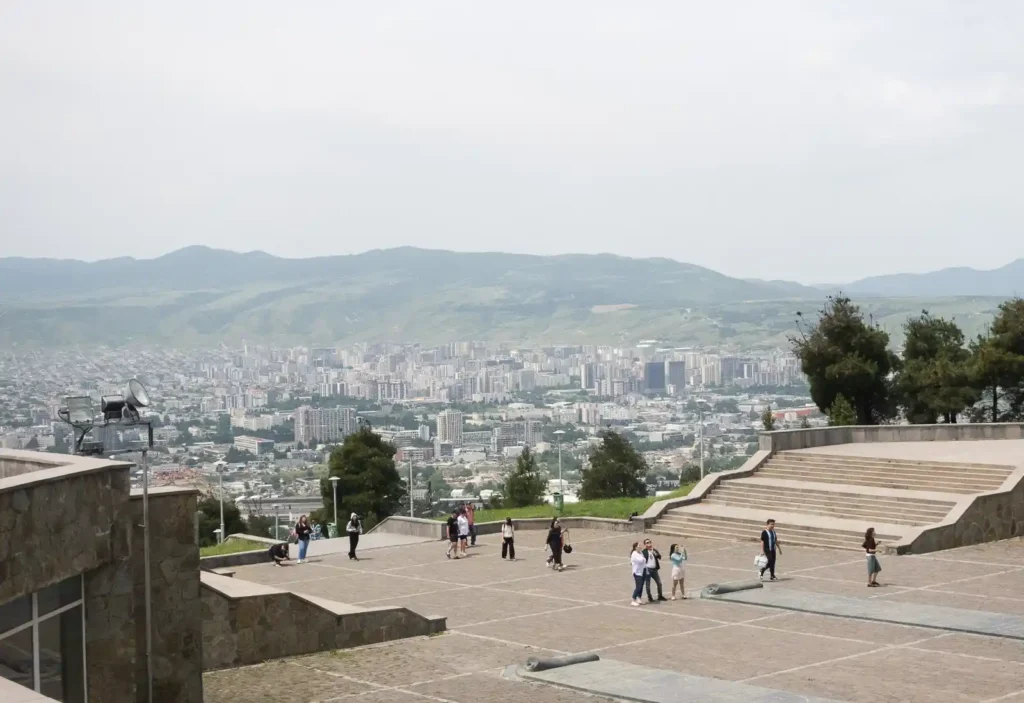
The only downside is that there are no explanations or descriptions regarding the images sculpted in the pillars, so it’s worth getting a guide or going with a tour if you wish to know more about the history that is portrayed. From its location on top the hill, the Chronicles of Georgia is also a great location from where to catch a stunning view of Tbilisi!
The site is not far from the Tbilisi Sea, a huge artificial lake that is open for swimming and other water activities. You’ll have to still walk a ways and there isn’t a whole lot of shade on the road, so make sure to bring sunscreen and hat if you plan to go for a swim.
Don’t forget to try out some typical Georgian dishes
Tbilisi is known for its extremely varied food scene.
There are all sorts of restaurants, from typical Georgian to South-East Asian and Western classics such as burgers, pizza and gyros. The cost of eating out is generally just below the average European restaurant, while typical Georgian eateries that cater mainly to locals can cost even less than half that.
Despite the assortment of eateries, however, it can be difficult to find a place to have breakfast if you’re an early riser. That’s because most places open late in the morning, usually starting around 9h30. We recommend booking a stay that includes breakfast, if you have the option to do so.
We tried a bit of everything during our visit, but our favourite place was without a doubt Ghebi, an authentic Georgian restaurant serving delicious classic dishes such as khinkali dumplings, cheese-stuffed mushrooms that were to die for, and hearty meat stews with potatoes. Suffice to say, we definitely ate a bit too much.
Most of the staff didn’t speak English, but we still managed to communicate via gestures and translation apps and they were extremely friendly and welcoming. Another thing that we loved about this restaurant is that it has an old juke box, which the other guests also seemed to enjoy since it was playing non-stop!


Tbilisi is one of the safest cities in the world
Tbilisi is super safe, even after dark.
Still, take the usual safety precautions such as avoiding unlit streets at night, and mind your belongings in very crowded areas such as old town and the metro.
Due to Georgia’s current political instability, there’s also chance you might encounter protests, especially around Liberty Square and the Parliament of Georgia. These events can sometimes turn violent, so it’s best you keep your distance, especially if you spot masked protesters and police in riot gear.
Let sleeping dogs lie
There are a lot of stray dogs, but they don’t really pay any attention to people.
Georgia uses the same system as Armenia to categorise the friendliness of dogs that have been captured, neutered and released. This is done by placing a coloured tag on the dog’s ear:
- Green tags indicate the dog should be friendly.
- Orange or yellow tags means the dog’s behaviour can be unpredictable.
- Red tags mean that the dog is aggressive and you should not approach it.
As in Armenia, this system is mainly indicatory of how the dog behaved around the people who treated it, and not necessarily how it will react to you.
In fact, the very first dog we came across in Georgia by the passport control checkpoint had a red tag and was the friendliest pup. He came to us, and kept returning for more pets and a little scratch behind the ears. Overall, it’s best to use your own judgement when it comes to stray dogs, especially since rabies is a risk in Georgia; if they don’t come to you it’s best to just leave them be.

We had a great time visiting Tbilisi, and we really feel like we only scratched the surface.
There is still so much we have to see and experience, and we can’t wait to go back and explore the rest of this incredible city!
We hope that our Tbilisi travel guide was helpful to you, and will help you on your future trips to the country of Georgia.


Hello, just wanted to tell you, I liked this article.
It was funny. Keep on posting!