When we first started buying knives to use both at home and outdoors, we often based our purchase on the looks of the knife above everything else.
That’s probably the case for most beginners. However, it wasn’t long before we learned how small differences in the design of the blade could make a huge difference in how well it cut, how long it could hold an edge and how durable it could be.
If you’re thinking of buying a knife for your outdoor activities, for work or even just to use in your kitchen, then stick around, we’re going to explain to you in simple terms what knife blade profiles and grinds are, why they are important and how you can recognise them!
Let’s get started.

Disclosure: This article contains affiliate links, and as Amazon associates we may get a small commission from qualifying purchases. We believe in only advertising products we trust in and use ourselves!
Let’s look at the profile of your knife
By profile, we simply mean the overall shape of the blade.
Depending on its profile, it can indicate that the knife is designed for a specific task or activity, such as bushcraft, hunting or even combat; that’s why it’s really important to learn how to recognise knife blade profiles. There are many different shapes, each with their own characteristics, and we’ll take a look at the most common ones.
The most common blade profile you’ll come across on the market is the drop point:
- This popular profile is used for everything from Swiss army knives to high-end survival blades. The spine (the unsharpened edge) is slightly sloped, and the blade gently curves until it meets the spine at the tip. This super versatile design allows for a durable blade and a lot of control when slicing through materials, while also being effective at piercing. When it comes to outdoor knives, it’s a typical design for meant for bushcraft and hunting.
- Most of our favourite outdoor knives use this design, such as the Mora Garberg, the Becker BK2 and the ESEE 4.
The drop point is also very similar to a straight back, the only difference being that the latter lacks the curved spine and is instead completely straight.
- The advantage of a straight spine is that it tends to give the knife more durability and slightly more weight when chopping and batoning (cutting through materials by hammering the back of the knife). Like the drop point, a straight back is a great choice for bushcraft, hunting and general outdoor tasks.
- Nowadays straight backs have become slightly more uncommon compared to drop points, but if you’re interested we absolutely recommend the TOPS Puukko, a fantastic knife for general outdoor use!
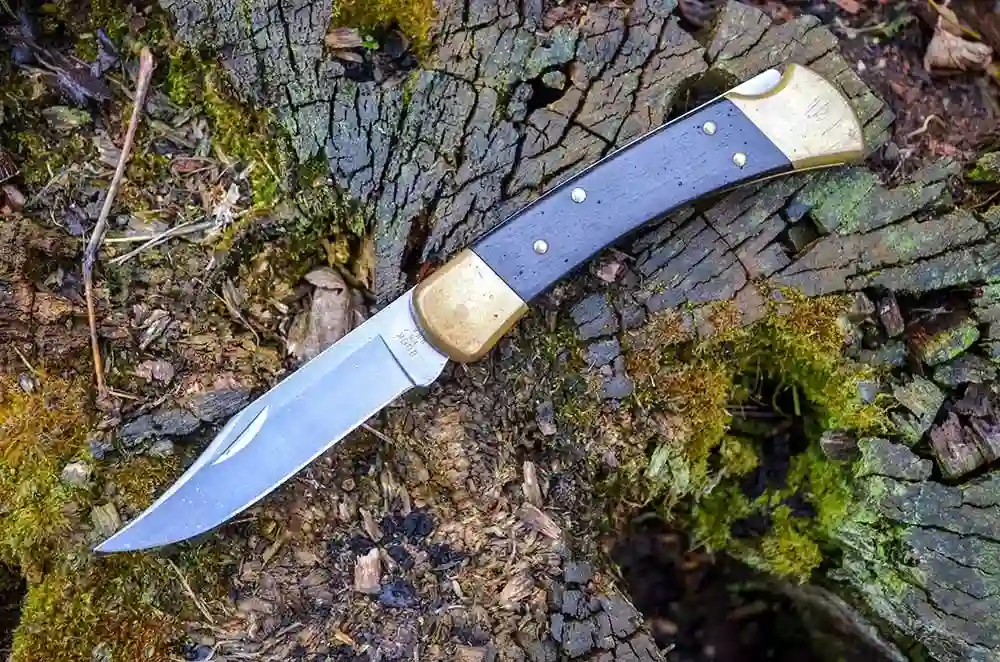
If you’re looking for cooler and more aggressive design, the clip point is definitely one to consider.
- Contrary to the drop point, the spine of a clip point knife curves towards the blade and creates a needle-sharp tip that is extremely effective at for piercing. This design is also great for slicing, which makes it a favourite for hunters and military personnel. The only disadvantage is that the very narrow tip is also more likely to bend and break if hit against a hard surface.
- One example we recommend you check out is the Buck 119 Special, one of the best clip point knives from one of our all-time favourite brands.
Another style that is very easy to spot is the tanto.
- Inspired by Japanese sword designs, a tanto can be recognised by the angle that the edge forms towards the tip: The spine usually follows a drop point or straight back design which, combined with angled tip, makes tantos amazing at piercing through materials. It’s a design that is more common on tactical and military knives and a great choice for the outdoors, since the overall shape also makes them extremely durable. With that said, the angle of the blade also makes tantos more challenging to sharpen.
- They are not our got-to knife design, but if you want to check one out then the Cold Steel GI Tanto is an affordable and reliable choice that have enjoyed trying out.

What is a knife grind?
A knife grind is the specific way the edge, along with the sides of the blade, have been shaped and sharpened, turning what was a basic stick of metal into a cutting tool.
Knife grinds are a little trickier to distinguish, and it took us a while to get the hang of it. Still, they are as important, if not more, than the profile of the knife, so let’s check out the most common types of knife grinds for outdoor knives.
If you were to look at a simple kitchen or pocket knife, chances are it has a flat grind.
- Simply put, what that means is that both sides are flat from the spine to the cutting edge. This results in a thin blade that is very easy to sharpen and very effective for cutting and slicing, hence why it’s so common to find in the kitchen. When it comes to the outdoors, flat grinds are typical of small knives meant for prepping food or cutting up carton, rope and other soft materials.
- You could also use a flat grind for hunting and general outdoor use without a problem, but you’ll have to keep in mind that they won’t hold an edge for very long, and because they are thin they also lack in overall durability.
- Overall, flat grinds are best for smaller knives, like the classic Opinel.
While flat grinds are common for smaller blades, you’re more likely to find larger knives with a sabre grind.
- In this case the blade has a bevel, a raised edge about halfway between the edge and the spine, that makes the blade thicker at the back and more durable than a flat grind. This makes sabre grind knives a top choice to use outdoors, even though they are marginally less sharp and a require a little more practice to sharpen than a flat grind.
- There are an infinite number of sabre grind knives to choose from, but if we had to pick our favourites we would recommend the Gerber Strongarm and the Ka-Bar BK7. Both these mid-sized knives are absolutely awesome and fun to use outdoors, and are durable enough to last you a lifetime!
There are two grinds that are a bit less common and more specific in their use, the hollow and the convex grind.
- With a hollow grind, the sides of the blade are concave and pushed slightly inwards towards the edge, which results in an extremely sharp knife with a strong spine. They are the best choice for hunting knives, such as the Buck 110, but a little less for bushcraft since they tend to not hold an edge for very long.
- This grind is often compared to full flat. When it comes to full flat grind vs hollow grind, however, we tend to go for the former due to the general better edge retention, although the superior cutting power of a hollow grind does give it the edge (no pun intended) in the right circumstances.
- A convex grind is basically the opposite of a hollow. Instead of the sides turning inwards, they are instead more rounded out, and the result is a sharp blade that can chop like an axe and holds an edge for a long time.
- It’s one of the best choices for outdoor survival knives, and that why you’ll find it often on high-end models such as the Fallkniven A1. Still, it’s not a grind we would recommend for beginners, because it is pretty difficult to sharpen.
Finally, let’s talk about scandis:
- Short for Scandinavian, they can be easily recognised by the large secondary edge that is uniform along the length of the blade, and are often considered the best choice for bushcraft and woodworking. Not only, scandis are very easy to sharpen, even for beginners, and hold a sharp edge for a good amount of time.
- The best scandi knife has to be the Mora Garberg, and yes, we know we have recommended it a thousand times, but this basic, no-nonsense bushcraft and survival knife is just too good not to mention.
- Since both are ideal for bushcraft, scandis are often put up against convex knives. When it comes to scandi vs convex grinds, we find scandis to be the most versatile of the two. Convex grinds can be really tricky to sharpen on the go and, while they excel at batoning and chopping, they are not as precise as scandis when it comes to fine work and bushcraft.
And there you have it!
These are the most common knife blade profiles and grinds you will come across when shopping for your next knife, whether it be for the outdoors, for EDC or for the kitchen.
If you want more tips on how to choose an outdoor knife, don’t forget to check out our dedicated article here.