Like many travellers who visit the Caucasus, we wanted to explore both Armenia and Georgia at the same time.
Given that the two countries border each other and are connected by road, rail and air, travelling between the two is really not difficult.
We decided to have some fun and take the sleeper train that connects the two capitals . This is how our trip went and our overall thoughts on it, as well as some useful information that will be helpful if you’re also planning this journey for the first time, such as where to get tickets and how much the trip cost us.
Let’s get started!
It’s better to buy tickets directly at the station
While it’s possible to buy tickets online, the train company’s website is pretty terrible, buggy and difficult to use.
It is, however, useful to check the schedule for the sleeper trains online. The night trains that connect both cities run every day during the months of July and August, and every other day the rest of the year.
After trying and failing to book our tickets online, we followed the advice of other travellers and simply bought them on location at the Yerevan Railway Station, which is also where the sleeper train departs from. If you’re coming from Tbilisi, then you’ll have to buy your ticket at Tbilisi Railway Station.
The tickets cost us 15615 AMD ($40) each, and we were told that we could only pay in cash, even though there were signs that indicated that card payments were accepted. Also, while seats don’t usually sell out (at least not third class), we still recommend you buy your ticket at least a few days in advance, just to be sure.

The differences between first, second and third class
The main difference between the various classes on the Yerevan-Tbilisi line comes down to privacy, personal preference and with how many people you travel with.
First class:
This is obviously the most expensive option, but it gets you a private two-bed cabin that can be locked for extra security. It’s the ideal option if you prefer not to interact with other passengers and simply want your own quiet space for the night.
Second class:
This is the same as first but with two bunk beds, housing a total of four people. The only reason it could be worth booking this one is if you want the benefits of first class but are travelling with more than two people.
Third class:
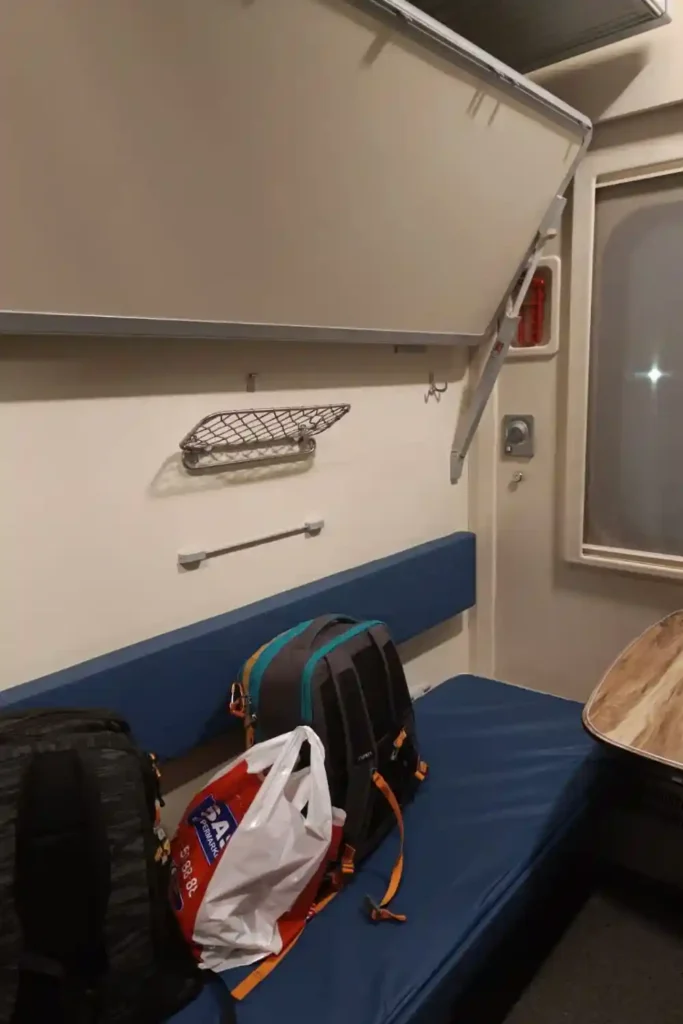
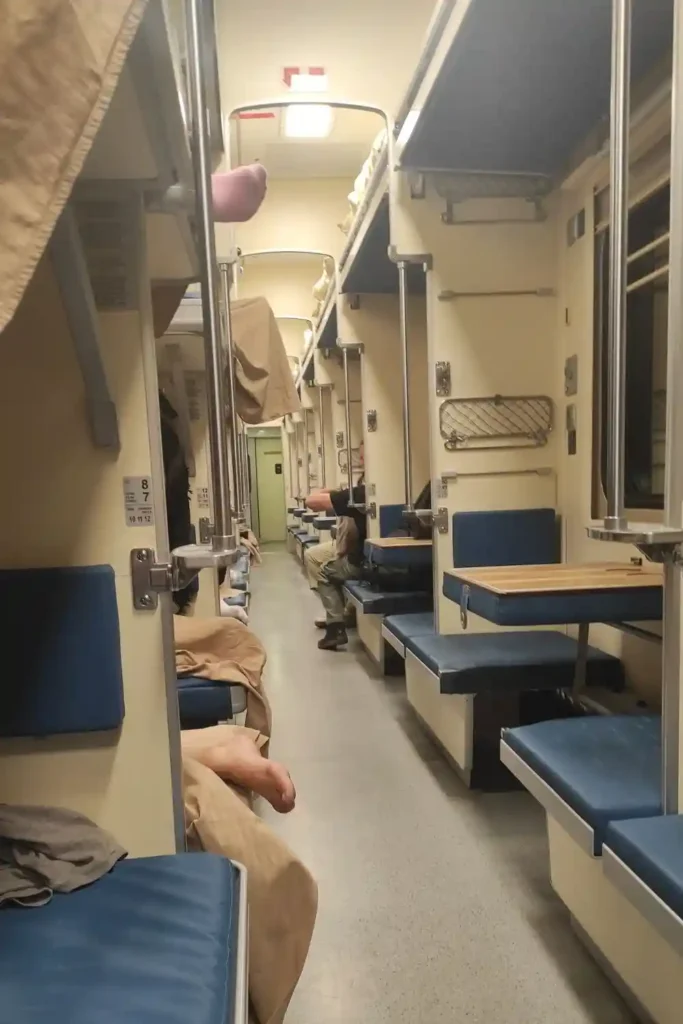
This is the option we chose for our trip. Third class compartments have two bunk beds, just like second class, with the only difference being that the space is open instead of being a closed cabin.
There is not a lot of space between the bunks and you’ll also share a table with your neighbours, so it can be a very social experience. At least it was for us, as we spent a good part of the night chatting and sharing snacks with a lovely Uruguayan-Brazilian couple who had the bunk in front of ours.
We did not expect the beds to be so comfortable
Shortly into the train ride, an attendant will come by with pillows and blankets so that you can make your own bed.
If you’re on the top bunk, you’ll need to bring it down from the wall by pressing two buttons, while if you’re on the bottom then your seat literally is the bed. It’s worth mentioning that the space between the top bunk and the storage rack above is quite small. Even Ana, being 1.55 m tall, couldn’t sit up completely, so take that into consideration when choosing your bed.
Speaking of storage, there is a large space underneath the bottom bunk that can easily fit at least a few large pieces of luggage, alongside a small rack next to the bed where you can store small items. And, as we mentioned before, the top bunk also has a large luggage rack; the only problem is that it’s high up, and you might struggle to get large or heavy bags to fit up there.
Even for third class, we found the berths to be a lot more comfy than we had expected, and we loved that we each had our night light and power outlets (USB for the top bunk). Once the lights got switched off and we got used to the noise and the rocking movement of the train, we slept extremely well. We also found the pillow to be very nice and fluffy, and the blankets were clean, even if a little stained (ugh).
The only downside is that our compartment was very hot and stuffy. We might have just been unlucky, however, because we’re pretty sure that other bunks next to us had fully functioning air conditioning.
When we asked the attendant if there was anyway to get the air conditioning to work he simply said “no”, shrugged and left, and that was the end of that. Fortunately the temperature dropped slightly during the night, making it a little easier to sleep.
Bring your own snacks and drinks
While there are water fountains in each wagon, there is no food available on the sleeper train, and it will not stop long enough for you to go out and buy something to eat.
We usually prefer not to go on long-distance journeys on a full stomach to reduce the chance motion sickness, so we had a light dinner a few hours before departure and brought a few light snacks, such as fruit and cookies.
It’s also worth packing something to have for breakfast in the morning. Most cafes in Tbilisi and Yerevan don’t open very early, and since the train arrives at your destination around 7h30 you’ll have to wait a bit before you can have a decent bite to eat.


The toilets are not great, not terrible
Each wagon has two toilets which, while not super clean, are functional enough.
There are soap dispensers in each bathroom, and even a decent sized shower if you want to wash up. We liked the fact that along with the sleeping kit we also got a small towel, so that is something that you won’t need to pack.
What’s missing, however, is toilet paper, so make sure to bring some paper tissues or wet wipes with you.
Passport control is easy and stress-free
Since the sleeper train crosses a national border we went through two passport controls, the first when exiting Armenia and a second when entering Georgia (or vice versa if coming from Tbilisi).
An attendant came to wake us up at around 2h30am, half-an-hour before reaching the border. An Armenian border patrol came aboard with a portable passport reader and a rather interesting looking box with an integrated camera. He then proceeded to take individual photos of each passenger and checked everyone’s documents directly at the assigned bunks.
On the other hand, when entering Georgia we were ordered out of the train and had to line up to show our passports and visas at a checkpoint.
What we’ve heard from other travellers, however, is that whether or not you’re asked to exit the train depends on the authorities, so you might have times where you need to exit twice and others where you just end up staying in the train the whole time. During the controls the officers were very friendly, although one passenger was removed from the train for reasons we didn’t learn. In total, the whole process took around two hours, and we crossed the Georgian border just after 5h00am.


Is it worth taking the sleeper train from Yerevan to Tbilisi?
Despite the close distance between them, flying from Yerevan to Tbilisi is a lot more expensive than the train, especially during the summer.
Renting a car and driving yourself is also doable, but you’ll pass over some poorly maintained mountain roads that require a good level of experience due to the danger they pose.
Another option is taking a marshrutka, a shared mini-bus common in Eastern Europe and former Soviet states, but to be honest we don’t really recommend those. We took two in Georgia to visit the northern part of the country, and it was one of the most terrifying things we’ve ever experienced during our travels.
The train, on the other hand, is pretty affordable, very comfortable, and overall just a very fun and different experience. The only thing that you need to be prepared for is getting up in the middle of the night to have your documents checked, but hey, it’s part of the adventure.
If you plan on visiting both Yerevan and Tbilisi, then we think the sleeper train is the best way to travel between the two capitals!